Pages

Showing posts with label punjabi glossary. Show all posts

Monday, 22 October 2012

History of Punjab

The History of Punjab is as old as the history of the Indian Civilization. The land of five rivers, this state was known as Panchal when the Aryans came to India in the third millennium BC. before that, the whole region of the Sindhu (Indus) and its tributaries were inhibited by the Harappans or the people of Copper age who constructed great cities in this region. Ropar in modern Punjab is a great example of this civilization. The Harappan culture declined suddenly between 1800-1700 BC and its end is as puzzling as its beginning. After the decline of the Harappans, Aryans from Central Asia ventured into this land and made this their home.

Punjab was the first place on the Indian subcontinent where the Aryans actually decided to settle after a long period of grazing and fighting with the aboriginal communities. This was the place where later parts of the Rgveda and other Vedas were written. This was also the place where first war for the control of entire north India or Aryawart (as it was known in those days) was fought between the Aryans and non-Aryans, known as Dasragya War (war of 10 kings).

Punjab always had a strategic importance due to its position on the famous Grand Trunk Road that connected the eastern parts of India to the extreme northwest point of Taxila (now in Afghanistan). This road was first constructed by Ashoka to have a better administration of the northwestern frontier, which was always a problem. After the decline of the Mauryan Empire, the Indo Greeks, Guptas, and Vardhans ruled this region in succession. After the coming of Muslims in the 9th-10th century AD, the region became an integral part of the Delhi Sultanate and the Mughal Empire. It was also under the Maratha rule for some time.

After the decline of the Mughal Empire, the most prominent ruler in this land was Maharaja Ranjit Singh in the early 19th century. After the death of Maharaja Ranjit Singh, the Sikhs could not hold on to their territory for long and the British controlled most of the region either directly or through the princely states.

The Partition of India in 1947 was a turning point for this state. Most of the Muslim dominated areas went out with Pakistan; while the Sikh and Hindu dominated areas remained with India. Lakhs of people were killed in the mayhem that engulfed in this region in the wake of the Partition. After independence, a new state of Punjab was created with modern day Haryana and Himachal Pradesh being a part of this state.

Sunday, 14 October 2012

Shri Guru Nanak Dev Ji - Pehli Patshai


Name: Shri Guru Nanak Dev Ji
 Date of Birth: October 20, 1469
 Place of Birth: Talwandi - Nankana Sahib (Pakistan)
 Father: Shri Kalyan Das Mehta (Shri Kalu Mehta)
 Mother: Mata Tripta
 Mahal(Wife): Mata Sulakhani
 Sons: Baba Shri Chand, Baba Lakhimi Das
 Year of Gurgadi: 1469
 Duration of Gurgadi: Entire life
 Ruler of the Time: Babar, Behol Lodhi, Sikandar Lodhi
 Date of Eternal Rest: September 22, 1539
 Place of Eternal Rest: Shri Kartarpur Sahib (Punjab)
 Total Age: 70 Years, 5 Months, 7 Days

It was during the time when the world was plunged into the dark world of ignorance, feudal tyranny and oppression, religious and cultural strife, that Siri Guru Nanak Dev, the founder of Sikhism, was born. His birthday is celebrated on the full moon night which mostly falls within November. Celestial music resounded in heaven. Almighty host of gods, thus, hailed his birth, "God has come to save the trouble peace to the people of all communities, preached brotherhood and humanitarianism irrespective of caste, creed, color and economic status. Guru Nanak Dev brought vision of a common humanity to a society which had become a heaven of violence and strife. He had faith in humanity. According to him, love of God implied love for his creation. Service of humanity indicates one's love for God.

"Miti Dhundh Jag Chanan Hoa,
Mitya Andhera Chan Charya"


That is "With the appearance if Guru Nanak Dev, the mist of ignorance disappeared and there was the light of righteousness, just as darkness is dispelled instantly when the sun rises and stars disappear".

According to Alfonso Di Nola, "Like many of Indian Saints and Prophets, Guru Nanak's birth was accompanied by supernatural signs and by celestial music. He lived his childhood in freedom of nature, but manifested very soon an exceptional tendency to mediation and isolation, refusing the company of his contemporaries."Read More.....

Friday, 12 October 2012

Gurbani


Nitnem Gutka
 
Gurbani is the term used by Sikhs to refer to any compositions of the Gurus. Gurbani is composed of two words: 'Gur' meaning 'the Guru's' and 'bani' meaning 'word'.

Extracts from Sri Guru Granth Sahib ji and Sri Dasam Granth ji are called Gutkas (small books) containing sections of Gurbani.

Respecting Gurbani
A Gutka is kept covered in a clean cloth. A person must wash their hands, feet and face, and cover his/her head before handling the Gutka. Gurbani should never be put on the floor or in a place which is lower than any furniture upon which a person may sit or lie.

A Gutka should never be taken to any place where any of the four major sins ("bajjar kurehats) are/do take place: sexual relationships outside of marriage, consumption of tobacco products (or any other intoxicants including alcohol), cutting or removal of hair from the body or consumption of meat or eggs.

Nitnem Banis
The 5 Banis Japji Sahib, Jaap Sahib, Tav-Parsad Savaiye, Benti Chaupai and Anand Sahib are recited daily by initiated Sikhs in the early morning (before 6am). Rehras Sahib is read in the evening (at sunset) and Kirtan Sohila before going to sleep at night.


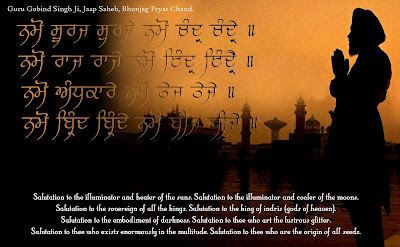
Jaap Sahib

jaap sahib
JAAP SAHIB
Jaap Sahib is the morning prayer of the Sikhs. The Prayer or Bani was complied by the tenth Sikh Master, Guru Gobind Singh. This Bani is one of 5 Banis that the Baptised Sikh must recite everyday and is recited by the Panj Pyare while preparing Amrit on the occasion of Amrit Sanchar (initiation), a ceremony held to admit initiates into the Khalsa Brotherhood.. The Jaap Sahib is the first Bani of the Dasam Granth, which is the second most holy book of the Sikhs and which was compiled entirely by the tenth master. It is often said that Jaap Sahib is Guru Gobind Singh’s Japji Sahib, and is the second Bani in the daily morning prayers of a Sikh.

Form
Jaap Sahib is made up of 199 verses and is the first Bani of the Dasam Granth (p.1-10). The Jaap Sahib begins with "Sri Mukhwakh Patshahi Dasvee," "By the holy mouth of the Tenth King." This appears to be a specific saying to authenticate the writings of Guru Gobind Singh himself.

Macauliffe says, "The Hindus have a work enitled Vishnu Sahasar Nam, 'Vishnu's Thousand Names.' The Jaapji was composed to supply the Sikhs with a similar number of epithets of the Creator."

Jap is a Sanskrit word which means "to utter in a low voice, whisper, mutter (especially prayers or incantations); to invoke or call upon in a low voice." The form of the word here is Japu, which makes it a noun, "meditation."

Language
The language of Jaap, is close to classical with words and compounds drawn from Sanskrit, Brij Bhasha, Arabic and Persian. The contents of Jaap Sahib, are divided into various Chhands bearing the name of the related meter according to the then prevalent system of prosody in India.Read More...

Wednesday, 10 October 2012

Rehras

The rehras is the evening prayer of the Sikhs. It is recited at the end of a working day. Its purpose is to add energy to one's being, and covers a Sikh's business actions and living environments. It is intended to help with physical weakness, poverty of money, property and other earthly matters, and feelings of hopelessness, unsuccessfulness or worthlessness.

Rehiras Sahib: Five different Gurus contributed to the evening prayer Guru Nanak Dev Ji; Guru Amardas Ji; Guru Ramdas Ji; Guru Arjan Dev ji and Guru Gobind Singh Ji. Each one enlightens another aspect of God.The Bayntee Chaopaee is Guru Gobind Singh Ji's personal prayer for protection and is said to liberate the soul. It is related to the element of water.

This evening Bani is recited by many Sikhs after a hard days work. When feeling tired, Sikhs, upon returning to home, have a wash and change into their indoor clothing and then together with the rest of their family recite this Bani. The recitation of Rehras Sahib adds energy to your body and mind. It allows you to conclude the day and thank the Almighty for the completion of another successful day. The verse speaks of the greatness of Waheguru and the ways in which ones actions will assist in attaining spiritual elevation. This Bani assists the person when he or she is weak physically,or financial,or with any other material and earthly matters. When you feel hopeless, unsuccessful or worthless, it will elevate you mentally and give you a fresh and positive view of things. Bayntee Chaopaee, which forms a part of Rehiras Sahib, is a Bani attributed to Guru Gobind Singh Ji. It is a Gurbani that is a personal prayer for physical and mental protection. It will also help liberate the mind and soul.