| ||
Celebration Sikhs celebrate the Maghi with an end to end recital of the holy Guru Granth Sahib and religious rituals in all the Sikh Gurudwaras. On the eve of Maghi falls the common Indian festival called the Lohri when bonfires are lighted in Hindu homes and alms are also distributed. . however The largest assembly, however, takes place at Muktsar (Punjab) where big fairs are organized and pilgrims take a holy dip in the sacred waters of sarovar and also visit several shrines. A mahala or big march of pilgrims from the main shrine to gurdwara Tibbi Sahib, sacred to Guru Gobind Singh, concludes the three-day celebration. | ||
Showing posts with label punjabi festivels. Show all posts
Showing posts with label punjabi festivels. Show all posts
Monday, 29 October 2012
Maghi


Lohri
| |||
| Prayers are offered to the bonfire seeking abundance & prosperity. People make merry by dancing & singing traditional folk songs. | |||
Lohri Festival Lohri festival is an annual thanksgiving day and an extremely popular harvest festival in India, epscially Northern India. Come January, and the fields of Punjab are filled with the golden harvest of wheat and farmers celebrate Lohri during this rest period before the cutting and gathering of crops. Time of Lohri According to the Hindu calendar, Lohri falls in mid-January (13th January). The earth, farthest from the sun at this point of time, starts its journey towards the sun, thus ending the coldest month of the year and announcing the start of the summer season. | |||
Lohri Celebrations | |||
 |
While Lohri is essentially a Punjab festival, it is celebrated in
some other states of North India as well. In cities like Delhi,
which have a predominant Punjabi population, Lohri is
celebrated to denote the last of the coldest days of winter.
Apart from Punjab, people from other northern Indian states of
Haryana, Delhi and parts of Himachal Pradesh, become busy
making preparations for Lohri. For them, Lohri is an
appropriate occasion to come out of their homes and celebrate the
harvesting of the Rabi (winter) crops and give in to relaxing and
enjoying the traditional folk songs and dances.
| ||
In houses that have recently seen pleasant happenings such as a marriage or childbirth, Lohri celebrations will reach a higher pitch of excitement. Punjabis usually have private Lohri celebrations, in their respective houses. Lohri rituals are performed, with the accompaniment of special Lohri songs. A bonfire is made and a prayer is performed to Agni, the god of Fire, and Prasad is distributed to all present. The prasad comprises of five main things - til, gazak, gur, moongphali (peanuts) and phuliya or popcorn. Milk and water are also poured around the bonfire. This ritual is performed for thanking the Sun God and seeking his continued protection. Singing and dancing form an intrinsic part of the celebrations. People wear their brightest clothes and come to dance the bhangra and gidda to the beat of the dhol. Punjabi songs are sung, and everybody rejoices. Sarson ka saag and makki ki roti is usually served as the main course at a Lohri dinner. Lohri is a great occasion that does not hold importance for farmers alone but also to those people residing in the urban area, as this festival provide the opportunity to interact with family and friends. Thus, Lohri is a socially significant festival for one and all. Lohri Celebrations in other Parts of India Lohri is celebrated throughout the country in different forms, as a harvest festival. It is called Pongal in the South, Bhugali Bihu in Assam, Bhogi in Andhra Pradesh and Sankranti in the central part of the country. Though modes of celebrating Lohri in India are different, but the message conveyed by the festival, that of setting aside differences and rejoicing by celebrating the end of the harvest season and the chilly winter is the same everywhere. | |||
Origin of Lohri | |||
| |||
Lohri marks the end of winter on the last day of Paush, and beginning of Magha (around January 12 and 13), when the sun changes its course. It is associated with the worship of the sun and fire and is observed by all communities with different names, as Lohri is an exclusively Punjabi festival. The questions like When it began and why is lost in the mists of antiquity. The origin of Lohri is related to the central character of most Lohri songs is Dulla Bhatti, a Muslim highway robber who lived in Punjab during the reign of Emperor Akbar. Besides robbing the rich, he rescued Hindu girls being forcibly taken to be sold in slave market of the Middle East. He arranged their marriages to Hindu boys with Hindu rituals and provided them with dowries. Understandably, though a bandit, he became a hero of all Punjabis. So every other Lohri song has words to express gratitude to Dulla Bhatti. | |||


Diwali
Diwali, also called Deepavali,
is a major Indian festival that is very significant in Hinduism,
Sikhism and Jainism. Known as the "Festival of Lights," it symbolises
the victory of good over evil, and lamps are lit as a sign of
celebration and hope for humankind. Celebrations focus on lights and
lamps, particularly traditional dīpa or deeya (earthen lamp,
as illustrated). Fireworks are associated with the festival. Diwali is a
colloquial name used in North India, while the festival is formally
called Deepavali in South India.
| |||
 | Diwali is celebrated for three consecutive days at the end of Hindu month of Ashwayuja. It usually occurs in October/November, and is one of the most popular and eagerly awaited festivals in India. Diwali comes exactly twenty days after Dussehra. Hindus and Sikhs alike regard it as a celebration of life and use the occasion to strengthen family and social relationships. For Hindus it is one of the most important festivals, and beginning of the year in some Hindu calendars. There are several beliefs regarding the origin of the holiday. The most repeated version is that Hindus celebrate Diwali to mark the time when Lord Rama achieved victory over Ravana. Some also view it as the day Krishna defeated the demon Narakasura or in honor of the day Bali went to rule the nether-world, obeying the order of Vishnu. It is also a significant festival for the Sikh faith. In India, Diwali is now considered to be more of a national festival, and the aesthetic aspect of the festival is enjoyed by most Indians regardless of faith. | ||
Dates in various calendars:
The festival is celebrated for a differing number of days by different communities. In Maharashtra and Karnataka, the celebrations start from Vasubaras, 12th day of the second fortnight of Ashvin (going on for 6 days) while in Northern India the celebrations start from Laxmi Puja the no moon day of the same month (going on for 2-3 days). Though the core days are common and fall on exactly the same set of days across India, they fall in different months depending on the version of the Hindu calendar being used in the given region. The Amanta ("ending on the no-moon") version of the Hindu Calendar has been adopted as the Indian national calendar. According to this calendar, which is prevalent in southern India and Maharashtra, the 6-day celebration is spread over the last four days of the month of Ashwayuja and the first two days of the new month of Kartika. According to the Purnimanta ("ending on the full-moon") version prevalent in northern India, it falls in the middle of the month of Ashwayuja/Ashvin. In the Gregorian calendar, it falls generally in the months of October or November. In 2006, it was celebrated on October 21 (Saturday). | |||
Significance in Hinduism:
The festival marks the victory of good over evil. The Sanskrit word Deepavali means an array of lights that stands for victory of brightness over darkness. As the knowledge of Sanskrit diminished, the name was popularly modified to Diwali, especially in northern India. In South India, Diwali does not coincide with the beginning of a new year as South Indians follow a different calendar, the Shalivahana calendar. On the day of Diwali, many wear new clothes, share sweets and snacks, and light firecrackers. Some North Indian business communities start their financial year on Diwali and new account books are opened on this day. Hindus find cause to celebrate this festival for different reasons:
| |||
| |||
| |||

Monday, 22 October 2012
Tourist Attractions in Punjab
The most important tourist center in the state is Amritsar with its Golden Temple.
This temple is considered to be the holiest of all the pilgrimages
of Sikhism and houses Akal Takht, the supreme governing body of
Sikhism. The Jalianwallah Bagh is a small park in the city where many
pilgrims were massacred by the British police in the year 1919.
Wagah is the only open land point between India and Pakistan. The Changing of Guards and the ceremonial lowering of the flags ceremony at sundown are great tourist attractions and have their own symbolic importance.
Ludhiana is famous for its hosiery and woolen goods and products from Ludhiana are exported all over the world. For its production of hosiery, Ludhiana is also known as the Manchester of India. It also boasts of the world famous Punjab Agricultural University, which organizes the Kisan Mela every Year. Nearby is Killa Raipur, which is famous for its Rural Olympics.
Patiala is famous for its healthy food, loving people, wonderful parandaas, exciting Patiala peg and jootis. Easily accessible and well maintained, Patiala is a place that would give one the much-needed tranquility far from urban chaos. The Sports School and the Moti Bagh Palace are some of the places that one must visit to get a clear picture of the past of the state.
If Varanasi symbolizes the spirit of ancient India, then Chandigarh is its city of 'today'. It is the capital of both Punjab and Haryana. The city is considered to be a Mecca of modern architecture and planning all over the world. What makes Chandigarh extraordinary is the fact that within four decades, a barren landscape has been transformed into a modern and model human habitation. The making of a new city is like inventing a new tomorrow. And Chandigarh succeeds in ushering in a new dawn. The major attractions of this city are the Capitol Complex, Secretariat, Assembly, High Court, Open Hand, City Beautiful, Garden City, Piazza, Tower of Shadows, Geometric Hill, Martyr's Memorial, Sukhna Lake, Rock Garden, Leisure Valley, Rose Garden, Garden of Tranquility, Garden of Rare Plants, Garden of Annuals, Bougainvillea Garden, Botanical Garden, Garden of Aromatic Plants, Government Museum and Art Gallery, Museum of Evolution of Life, and International Dolls Museum.
Jalandhar is an ancient city but not much of its evidence is left now. Today, it is a major rail and road junction and an army cantonment.
The Yadavendra Gardens 24 kilometers on the Shimla road at Pinjore has charming Mughal style terraced lawns, flower beds, fountains, water channels and airy pavilions enclosed by high walls swathed in the mauve and magenta bougainvillea.
Wagah is the only open land point between India and Pakistan. The Changing of Guards and the ceremonial lowering of the flags ceremony at sundown are great tourist attractions and have their own symbolic importance.
Ludhiana is famous for its hosiery and woolen goods and products from Ludhiana are exported all over the world. For its production of hosiery, Ludhiana is also known as the Manchester of India. It also boasts of the world famous Punjab Agricultural University, which organizes the Kisan Mela every Year. Nearby is Killa Raipur, which is famous for its Rural Olympics.
Patiala is famous for its healthy food, loving people, wonderful parandaas, exciting Patiala peg and jootis. Easily accessible and well maintained, Patiala is a place that would give one the much-needed tranquility far from urban chaos. The Sports School and the Moti Bagh Palace are some of the places that one must visit to get a clear picture of the past of the state.
If Varanasi symbolizes the spirit of ancient India, then Chandigarh is its city of 'today'. It is the capital of both Punjab and Haryana. The city is considered to be a Mecca of modern architecture and planning all over the world. What makes Chandigarh extraordinary is the fact that within four decades, a barren landscape has been transformed into a modern and model human habitation. The making of a new city is like inventing a new tomorrow. And Chandigarh succeeds in ushering in a new dawn. The major attractions of this city are the Capitol Complex, Secretariat, Assembly, High Court, Open Hand, City Beautiful, Garden City, Piazza, Tower of Shadows, Geometric Hill, Martyr's Memorial, Sukhna Lake, Rock Garden, Leisure Valley, Rose Garden, Garden of Tranquility, Garden of Rare Plants, Garden of Annuals, Bougainvillea Garden, Botanical Garden, Garden of Aromatic Plants, Government Museum and Art Gallery, Museum of Evolution of Life, and International Dolls Museum.
Jalandhar is an ancient city but not much of its evidence is left now. Today, it is a major rail and road junction and an army cantonment.
The Yadavendra Gardens 24 kilometers on the Shimla road at Pinjore has charming Mughal style terraced lawns, flower beds, fountains, water channels and airy pavilions enclosed by high walls swathed in the mauve and magenta bougainvillea.
History of Punjab
The History of Punjab is as old as the history of the Indian
Civilization. The land of five rivers, this state was known as
Panchal when the Aryans came to India in the third millennium BC.
before that, the whole region of the Sindhu (Indus) and its
tributaries were inhibited by the Harappans or the people of Copper
age who constructed great cities in this region. Ropar in modern Punjab
is a great example of this civilization. The Harappan culture
declined suddenly between 1800-1700 BC and its end is as puzzling as
its beginning. After the decline of the Harappans, Aryans from
Central Asia ventured into this land and made this their home.
Punjab was the first place on the Indian subcontinent where the Aryans actually decided to settle after a long period of grazing and fighting with the aboriginal communities. This was the place where later parts of the Rgveda and other Vedas were written. This was also the place where first war for the control of entire north India or Aryawart (as it was known in those days) was fought between the Aryans and non-Aryans, known as Dasragya War (war of 10 kings).
Punjab always had a strategic importance due to its position on the famous Grand Trunk Road that connected the eastern parts of India to the extreme northwest point of Taxila (now in Afghanistan). This road was first constructed by Ashoka to have a better administration of the northwestern frontier, which was always a problem. After the decline of the Mauryan Empire, the Indo Greeks, Guptas, and Vardhans ruled this region in succession. After the coming of Muslims in the 9th-10th century AD, the region became an integral part of the Delhi Sultanate and the Mughal Empire. It was also under the Maratha rule for some time.
After the decline of the Mughal Empire, the most prominent ruler in this land was Maharaja Ranjit Singh in the early 19th century. After the death of Maharaja Ranjit Singh, the Sikhs could not hold on to their territory for long and the British controlled most of the region either directly or through the princely states.
The Partition of India in 1947 was a turning point for this state. Most of the Muslim dominated areas went out with Pakistan; while the Sikh and Hindu dominated areas remained with India. Lakhs of people were killed in the mayhem that engulfed in this region in the wake of the Partition. After independence, a new state of Punjab was created with modern day Haryana and Himachal Pradesh being a part of this state.
Punjab was the first place on the Indian subcontinent where the Aryans actually decided to settle after a long period of grazing and fighting with the aboriginal communities. This was the place where later parts of the Rgveda and other Vedas were written. This was also the place where first war for the control of entire north India or Aryawart (as it was known in those days) was fought between the Aryans and non-Aryans, known as Dasragya War (war of 10 kings).
Punjab always had a strategic importance due to its position on the famous Grand Trunk Road that connected the eastern parts of India to the extreme northwest point of Taxila (now in Afghanistan). This road was first constructed by Ashoka to have a better administration of the northwestern frontier, which was always a problem. After the decline of the Mauryan Empire, the Indo Greeks, Guptas, and Vardhans ruled this region in succession. After the coming of Muslims in the 9th-10th century AD, the region became an integral part of the Delhi Sultanate and the Mughal Empire. It was also under the Maratha rule for some time.
After the decline of the Mughal Empire, the most prominent ruler in this land was Maharaja Ranjit Singh in the early 19th century. After the death of Maharaja Ranjit Singh, the Sikhs could not hold on to their territory for long and the British controlled most of the region either directly or through the princely states.
The Partition of India in 1947 was a turning point for this state. Most of the Muslim dominated areas went out with Pakistan; while the Sikh and Hindu dominated areas remained with India. Lakhs of people were killed in the mayhem that engulfed in this region in the wake of the Partition. After independence, a new state of Punjab was created with modern day Haryana and Himachal Pradesh being a part of this state.
Sunday, 21 October 2012
About Karva Chauth Festival
A married woman
who observes this vrat is called ‘Saubhagyavati’ (joyous and happy
state of wifehood). "Let the offerings of this Karwa (Karak (gift bring
long life to my husband and may my saubhagya be everlasting". And
express such desire that ‘May my death precede that of my husband so
that I can enter the chitaa (funeral pyre) as a bride (not as a widow).
This katha (narrative) first took place between Siva and parvati. Siva told Parvati about the significance of Karwa Vrat. In Dwapar Yuga, Draupadi asked Lord Krishna about the vrat of Karwa Chauth. Thereafter, the very first time this vrat was observed in the town of Shukraprastha by Veeravati, the daughter of Vedsharma and Leelavati. Ever since this vrat has been observed by married women till the present day. |  | ||
The fast of Karwa Chauth is of particular importance to Hindu women as they believe it ensures the well-being, prosperity and longevity of their husbands. Thus Karwa Chauth started as a festival to celebrate the friendship (relationship) between the once-brides and their god-friends (god-sisters). Karwa Chauth has become more of a community festival Karwa Chauth is one such occasion when most married Hindu women in North India seek the blessings of God for their husband's long life. Karwa Chauth is observed on the fourth day of the dark fortnight of Ashwin, which is also called Kartik according to some calendars. Karwa Chauth falls about nine days before Diwali. It is the most important fast observed by Hindu women of North India. On this day married Hindu women offer prayers seeking the welfare, prosperity, and a long life of their husbands. Though it is a day marked with neither food nor water, this festival is quite popular among the newly weds. A few days before the festival, markets are full of items needed for the festival. The preparations for this festival start a week in advance. The day of Karwa Chauth is celebrated mostly amongst the entire North Indian community settled either in India and other parts of the world. The most important aspect of this day is that a dawn to dusk fast is undertaken by the North Indian ladies and seeing the moon they finally break the fast. The fast is unique perhaps because nowhere in the world does a wife go without food or water just to pray for the longevity and well-being of her husband. | |||
| |||
Early in the morning they prepare food and have it before sunrise. The morning passes by in other festive activities like decorating hand and feet with heena, decorating the pooja thali and meeting friends and relatives. Read more..... | |||

Friday, 19 October 2012
Asa Di Var

Asa Di Var is a collection of 24 pauris or stanzas
written by Guru Nanak Devji (Sri Guru Granth Sahib, page 462-475). The
founder of Sikhism, Guru Nanak Dev ji wrote the first 9 together on one
occasion and later wrote 15 more stanzas on a different occasion. These
two parts were then compiled together by the 5th Guru, Guru Arjan Dev
ji in 1604 AD.
When Guru Arjan Dev ji was compiling
the Holy Granth, he added a few Sloks of Guru Nanak and in some cases
Guru Angad Dev ji, the second Guru of the Sikhs. These Sloks are tied
together in a way that they relate to the same theme as highlighted in
the pauri. In its present form, the Asa Di War contains a few more
shabads recited by Guru Ram Das, the fourth Sikh Guru.
The Asa
Di War kirtan is recited in the early morning hours in a very melodious
way and style as mentioned by Guru Arjan Dev Ji called "Tunde Asraje
Ki Dhuni" after the name of the contemporary brave and pious king
Asraj. One of the hands of the king was amputated, so he was called
Tunda meaning crippled. The deeds and the ode of this king was sung by
the bards in that typical fashion which then was extremely popular and
melodious and was therefore adopted to performing Asa Di War.
Tuesday, 16 October 2012
Ardas
The Ardas
is a Sikh prayers that is a done before performing or after undertaking
any significant task; after reciting the daily Banis (prayers); or
completion of a service like the Paath, kirtan (hymn-singing) program or
any other religious program. In Sikhism, these prayers are also said
before and after eating. Though these prayers vary by sect, all observe
them as an important rite of the day. The prayer is a plea to God to
support and help the devotee with whatever he or she is about to
undertake or has done.
The Ardas is usually always done standing up with folded hands. The beginning of the Ardas is strictly set by the tenth Sikh Guru, Guru Gobind Singh. When it comes to conclusion of this prayer, the devotee uses word like "Waheguru please bless me in the task that I am about to undertake" when starting a new task or "Akal Purakh, having completed the hymn-singing, we ask for your continued blessings so that we can continue with your memory and remember you at all times", etc. | |
Origins The word "Ardās" is derived from Persian word 'Arazdashat', meaning a request, supplication, prayer, petition or an address to a superior authority. Ardās is a unique prayer based on the fact that it is one of the few well-known prayers in the Sikh religion that was not written in its entirety by the Gurus. The Ardās cannot be found within the pages of the Guru Granth Sahib because it is a continually changing devotional text that has evolved over time in order for it to encompass the feats, accomplishments, and feelings of all generations of Sikhs within its lines. Taking the various derivation of the word Ardās into account, the basic purpose of this prayer is an appeal to Waheguru for his protection and care, as well as being a plea for the welfare and prosperity of all mankind, and a means for the Sikhs to thank Waheguru for all that he has done. | |
Meaning The Ardas is said as a reflection on everything it took for the Divine to create the pure Shabad Guru on earth and to remember all that the Sikh endured to protect it and ensure it landed in the hands of the future generation. It encompasses many Sikh and Humanistic values, such as peace and understanding, as well as faith and perseverance.READ MORE... |
Friday, 12 October 2012
Jaap Sahib
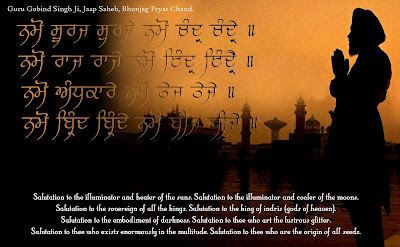 |
| JAAP SAHIB |
Jaap Sahib
is the morning prayer of the Sikhs. The Prayer or Bani was complied by
the tenth Sikh Master, Guru Gobind Singh. This Bani is one of 5 Banis
that the Baptised Sikh must recite everyday and is recited by the Panj
Pyare while preparing Amrit on the occasion of Amrit Sanchar
(initiation), a ceremony held to admit initiates into the Khalsa
Brotherhood.. The Jaap Sahib is the first Bani of the Dasam Granth,
which is the second most holy book of the Sikhs and which was compiled
entirely by the tenth master. It is often said that Jaap Sahib is Guru Gobind Singh’s Japji Sahib, and is the second Bani in the daily morning prayers of a Sikh.
|
Form Jaap Sahib is made up of 199 verses and is the first Bani of the Dasam Granth (p.1-10). The Jaap Sahib begins with "Sri Mukhwakh Patshahi Dasvee," "By the holy mouth of the Tenth King." This appears to be a specific saying to authenticate the writings of Guru Gobind Singh himself. Macauliffe says, "The Hindus have a work enitled Vishnu Sahasar Nam, 'Vishnu's Thousand Names.' The Jaapji was composed to supply the Sikhs with a similar number of epithets of the Creator." Jap is a Sanskrit word which means "to utter in a low voice, whisper, mutter (especially prayers or incantations); to invoke or call upon in a low voice." The form of the word here is Japu, which makes it a noun, "meditation." |
Language The language of Jaap, is close to classical with words and compounds drawn from Sanskrit, Brij Bhasha, Arabic and Persian. The contents of Jaap Sahib, are divided into various Chhands bearing the name of the related meter according to the then prevalent system of prosody in India.Read More... |
Sunday, 7 October 2012
Guru Granth Sahib Ji
 Guru Granth Sahib Ji
Compiled by: Shri Guru Arjan Dev Ji in 1604 A.D.
Contributors:
Gurus:
* Shri Guru Nanak Dev Ji
* Shri Guru Amar Das Ji
* Shri Guru Arjan Dev Ji
* Shri Guru Gobind Singh Ji
* Shri Guru Angad Dev Ji
* Shri Guru Ram Das Ji
* Shri Guru Tegh Bahadur Ji
Bhagatas:
* Jai Dev (b. 1170 A.D.)
* Shaikh Farid (1173-1266 A.D.)
* Trilochan (b. 1267 A.D.)
* Namdev (b. 1270 A.D.)
* Sadhana (b. 13th Century A.D.)
* Ramanand (b. 1359 A.D.)
* Kabir (1398-1494 A.D.)
* Dhana (b. 1415 A.D.)
* Pipa (b.1425 A.D.)
* Sain (b.15th Century A.D.)
* Ravi Das (b.15th Century A.D.)
* Bhikhan (d. 1574 A.D.).
* Sur Das (b. 1529 A.D.)
* Baini
* Parmanand
Minstrels and Bards:
* Bhai Mardana (b. 15th-16th Century A.D.)
* Sundar (1560-1603 A.D.)
* Kal, Kalsahar, Tal, Jalap, Jal, Kirat, Sal, Bhalah, Nalah, Bhikkh, Jalan, Das, Gyand, Sewak, Mathura, Bal, Haribans, Satta & Rai Balvand.
Note: No information regarding life period and place of birth is available about the Bards from Kal to Balvand.
Total numbers of hymns: 5867
Total numbers of pages: 1430
Total numbers of Ragas: 31
First Prakash: October 16, 1604 A.D. at Harimandar Sahib, Amritsar.
First Granthi: Baba Buddha Ji (1506-1630 A.D.)
Final Shape: The final shape to Guru Granth Sahib was given by Guru Gobind Singh at Damadama Sahib in Panjab during 1705-1706 A.D.
Succession to Gurugaddi: On October 7, in the year 1708 A.D. before his departure from the world Guru Sahib instructed the Sikhs as to rever Shri Guru Granth Sahib Ji as (their) Puran GuruRead More.....
Sikh scripture
Message Of Guru Granth Sahib
The Guru Granth Sahib promotes SGGS(Shri Guru Granth Sahib),
a moral teaching that Sahib explains is about living a life of Truth,
respect for others, and high moral standards. Followers of the Guru are
considered to be members of the Sikh religion, and they are known as
Gurmukh – which literally means “follower of Guru”
All Peoples of the World are Equal
The Guru Granth Sahib promotes the message of equality of all beings and at the same time state that Sikh believers "obtain the supreme status" (SSGS, Page 446). Discrimination of all types is strictly forbidden based on the Sikh tenet Fatherhood of God which states that no one should be reckoned low or high, stating that instead believers should - “reckon the entire mankind as One” (Akal Ustat, 15.85).
Sri Guru Granth Sahib promotes the concept of equality by highlighting the fact that we are made of the same flesh, blood and bone and we have the same light of God with us – Soul . Our building bricks are the same:
The Guru Granth Sahib promotes SGGS(Shri Guru Granth Sahib),
a moral teaching that Sahib explains is about living a life of Truth,
respect for others, and high moral standards. Followers of the Guru are
considered to be members of the Sikh religion, and they are known as
Gurmukh – which literally means “follower of Guru”
All Peoples of the World are Equal
The Guru Granth Sahib promotes the message of equality of all beings and at the same time state that Sikh believers "obtain the supreme status" (SSGS, Page 446). Discrimination of all types is strictly forbidden based on the Sikh tenet Fatherhood of God which states that no one should be reckoned low or high, stating that instead believers should - “reckon the entire mankind as One” (Akal Ustat, 15.85).
Sri Guru Granth Sahib promotes the concept of equality by highlighting the fact that we are made of the same flesh, blood and bone and we have the same light of God with us – Soul . Our building bricks are the same:
Saturday, 6 October 2012
Mirza Sahiba -Tragic Romance
| Mirza-Sahiban | ||||||||||
Story
Mirza-Sahiban, a love-lore is a treasure of Punjabi literature. It is a romantic tragedy. Sahiban was another love-lorn soul. Shayer Pillo raves about her beauty and says," As Sahiban stepped out with a lungi tied around her waist, the nine angels died on seeing her beauty and God started counting his last breath..." Mirza and Sahiban who were cousins and childhood playmates, fell in love with each other. But when this beauty is about to be wedded forcibly to Tahar Khan by her parents, without any hesitation she sends a taunting message to Mirza, whom she loves, to his village Danabad, through a Brahmin called Kammu. "You must come and decorate Sahiban’s hand with the marriage henna." Mirza Khan was the son of Wanjhal Khan, the leader of the Kharal tribe in Danabad, a town in the Jaranwala area of Faisalabad. Sahiba was the daughter of Mahni, the chief of Khewa, a town in Sial Territory in the Jhang district. This is the time you have to protect your self respect and love, keep your promises, and sacrifice your life for truth. Mirza who was a young full-blooded man, makes Sahiba sit on his horse and rides away with her. But on the way, as he lies under the shade of a tree to rest for a few moments, the people who were following them on horseback with swords in their hands catch up with them. Sahiba was a virtuous and a beautiful soul who did not desire any bloodshed to mar the one she loved. She did not want her hands drenched in blood instead of henna. She thinks Mirza cannot miss his target, and if he strikes, her brothers would surely die. Before waking up Mirza, Sahiban breaks his arrows so he can't use them. She presumes on seeing her, her brothers would feel sorry and forgive Mirza and take him in their arms. But the brothers attack Mirza and kill him. Sahiban takes a sword and slaughters herself and thus bids farewell to this world. Innumerable folk songs of Punjab narrate the love tale of Sassi and Punnu. The women sing these songs with great emotion and feeling, as though they are paying homage to Sassi with lighted on her tomb. It is not the tragedy of the lovers. It is the conviction of the heart of the lovers. It is firmly believed that the soil of the Punjab has been blessed. God has blessed these lovers to. Though there love ended in death, death was a blessing in disguise, for this blessing is immortalized. Waris shah who sings the tale of Heer elevates mortal love to the same pedestal as spiritual love for God saying," When you start the subject of love, first offer your invocation to God". This has always been the custom in Punjab, where mortal love has been immortalized and enshrined as spirit of love. Just as every society has dual moral values, so does the Punjabi community. Everything is viewed from two angles, one is a close up of morality and the other is a distant perspective. The social, moral convictions on one hand give poison to Heer and on the other make offerings with spiritual convictions at her tomb, where vows are made and blessings sought for redemption from all sufferings and unfulfilled desires. But the Sassis, Heers, Sohnis and others born on this soil have revolted against these dual moral standards. The folk songs of Punjab still glorify this rebelliousness. "When the sheet tear, It can be mended with a patch: How can you darn the torn sky? If the husband dies, another one can be found, But how can one live if the lover dies?" And perhaps it is the courage of the rebellious Punjabi woman, which has also given her a stupendous sense of perspective. Whenever she asks her lover for a gift she says, " Get a shirt made for me of the sky And have it trimmed with the earth" Mirza was sent to his relatives' house in Khewa to study, where he met Sahiba and they fell in love. Her family opposed the relationship, and instead arranged a marriage with a member of the Chadhar family. To keep them apart, they confined her in the house, but she contacted Mirza through a messenger. He arrived on his horse, Bakki the night before the wedding and secretly carried her away, planning to elope. However, Sahiba's brothers caught up with them the next day and killed Mirza. Sahiba killed herself. |
Sohni Mahiwal-The Tragic Romance
Sohni Mahiwal
Sohni Mahiwal is one of the four popular tragic romances of the Sindh. The other three are Heer Ranjha, Mirza Sahiba, and Sassi Punnun.
|
Sohni, the potter's daughter Sohni was the daughter of a potter named Tula, who lived in the Punjab near the banks of the Sindhu. As soon as the 'Surahis' (water pitchers) and mugs came off the wheels, she would draw floral designs on them and transform them into masterpieces of art. |
Izzat Baig of Bukhara Izzat Biag, the rich trader from Bukhara (Uzbekistan), came to India on business but when he saw the beautiful Sohni, he was completely enchanted. Instead of keeping 'mohars' (gold coins) in his pockets, he roamed around with his pockets full of love. Just to get a glimpse of Sohni, he would end up buying the water pitchers and mugs everyday. Sohni lost her heart to Izzat Baig. Instead of making floral designs on earthenware, she started building castles of love in her dreams. Izzat Baig sent off his companions to Bukhara. He took up the job of a servant in the house of Tula, Sohni's father. He would even take their buffaloes for grazing. Soon, he came to be known as "Mahiwal"(buffalo herder). |
Sohni's marriage When the people started spreading rumours about the love of Sohni and Mahiwal, without her consent her parents arranged her marriage with another potter. Suddenly, one day his "barat" (marriage party) arrived at the threshold of her house. Sohni was helpless and in a poignant state. Her parents bundled her off in the doli (palanquin), but they could not pack off her love in any doli (box). Izzat Baig renounced the world and started living like a "faqir" (hermit) in a small hut across the river. The earth of Sohni’s land was like a dargah (shrine) for him. He had forgotten his own land, his own people and his world. Taking advantage of the darkness of the night, when the world was fast asleep, Sohni would come by the riverside and Izzat Baig would swim across the river to meet her. He would regularly roast a fish and bring it for her. It is said that once, when due to high tide he could not catch a fish, Mahiwal cut a piece of his thigh and roasted it. Seeing the bandage on his thigh, Sohni opened it, saw the wound and cried. |
The End From the next day, Sohni started swimming across the river with the help of an earthen pitcher as Izzat Baig was so badly wounded and could not swim across the river. Soon, the rumours of their romantic rendezvous spread. One-day Sohni’s sister-in-law followed her and saw the hiding place where Sohni used to keep her earthen pitcher among the bushes. The next day, the sister-in-law removed the hard baked pitcher and replaced it with an unbaked one. That night, when Sohni tried to cross the river with the help of the pitcher, it dissolved in the water and Sohni was drowned. From the other side of the river, Mahiwal saw Sohni drowning and jumped into the river and drowned as well. |
Sohni's Tomb The Tomb Of Sohni In Shahdapur City Sindh, which is 75 km from (Hyderabad). According to the legend the bodies of Sohni Mahiwal were recovered from river Indus near Shahdapur and hence are buried there. An Indian film was also made with the name Sohni-Mahiwal(1984) starring Sunny Deol and Poonam Dhillon. |
Sunday, 30 September 2012
Punjabi Dress
Punjabi Dress

A
generation ago, the turban was the "crowning glory" of all Punjabis
whether Muslim, Hindu or Sikh. Muslims and Hindus have given up their
turbans, but it remains, literally, an article of faith for Sikh men
whose religion forbids them to cut their hair. The kurta, a long
straight-cut, loose shirt teamed with pyjamas, the loose baggy salwar
or a kind of sarong called a loongi or tehmat makes up the traditional
dress for men. Winter sees the rustic Punjabi in colourful sweaters
that wives and mothers are so skilled in making. A blanket finishes his
ensemble. When the urban, educated Punjabi steps out to work he will be
in shirt and pant or a suit-sartorially indistinguishable from his
counterparts in Tokyo or Toronto. Back home in the evening, he is
likely to be found in more traditional dress. The traditional Punjabi
shoes, called juttis retain their popularity with both rural and urban
men; they are both elegant and comfortable. Patiala and Muktsar are
famous for juttis.
It is impossible to tell by dress whether a Punjabi woman is a Hindu, Muslim, Sikh or Christian – they all dress in salwar topped by a kameez (a garment that can be fitted like a dress loose like the kurta) and accented by a rectangular scarf about 2.5 metres long called the chunni or duppatta.She’s fond of her sweaters, but she is passionately proud of her collection of woollen shawls. These can be breathtaking. The women of Punjab are responsible for the state’s most famous item of handicraft - the phulkari. |
| Traditional Dresses: |
| Phulkari |
| Turban |
| Salwar Kameez |
| Punjabi Jutti |
| Saggi Phull |
| Parandi |

Subscribe to:
Posts (Atom)

